Magnet bonding adhesives are structural adhesives used to permanently fix rare-earth, ferrite, samarium cobalt or alnico magnets to metal, plastic or composite substrates without mechanical fasteners. In Equipment for Aerospace & Defense (AAED), where permanent magnets sit inside actuators, sensors, electric motors and guidance systems, the right magnet bonding adhesive determines whether an assembly survives vibration, thermal cycling and decades of service without a single magnet shifting out of place.
Key Takeaways
- Magnet bonding adhesives replace mechanical clamping and fasteners, distributing mechanical stress evenly across the bond line and avoiding damage to brittle magnet substrates.
- Adhesive choice depends on the magnet type – neodymium (NdFeB), samarium cobalt (SmCo), ferrite or alnico – each with different brittleness, temperature limits and corrosion behaviour.
- Epoxies, structural acrylics, cyanoacrylates, anaerobics and silicones each suit different combinations of substrate, cure speed and operating environment in AAED equipment.
- E-coated magnets (epoxy, polyimide, rubber or PTFE-based coatings) often need surface treatment such as plasma, corona or mechanical abrasion before bonding.
- Selection criteria for AAED programmes include substrate and coating, environmental exposure, cure speed and processing conditions, and mechanical load and bond geometry.
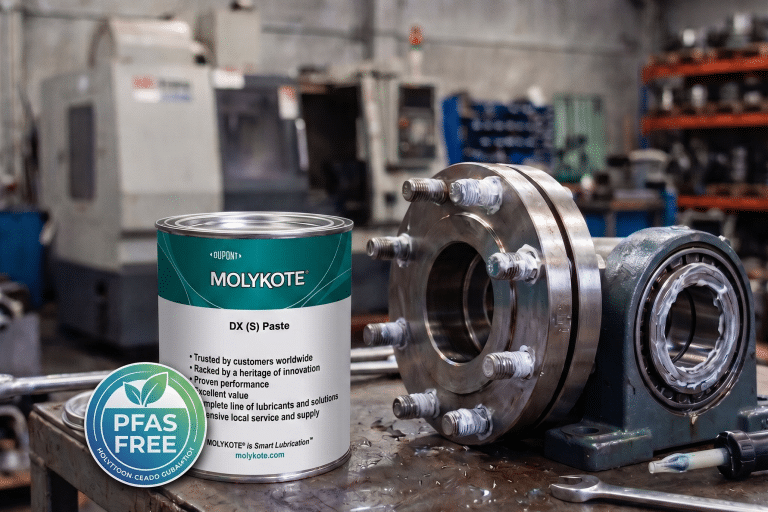
- Bonded magnet assemblies in AAED equipment typically sit inside motors, actuators and gearboxes that also depend on specialty lubricants engineered for wide temperature ranges and low outgassing.
Why AAED Equipment Increasingly Relies on Bonded Magnets
Permanent magnets are no longer confined to consumer electronics and electric vehicles. Across Equipment for Aerospace & Defense (AAED), more-electric actuation, sensor miniaturisation and electrified propulsion are pushing magnet content into platforms that previously relied on hydraulic or purely mechanical systems. Flight control actuators, UAV propulsion motors, radar and avionics sensors, satellite reaction wheels and guidance instrumentation all depend on permanent magnets held precisely in place over the equipment’s full service life.
Europe’s wider aerospace and defence sector reflects this trajectory: turnover reached €325.7 billion in 2024, up 10.1% year on year, with employment growing by 6.9% to over 1.1 million jobs across roughly 4,000 companies, according to ASD Europe’s 2024 industry figures. As programmes scale, the materials used to assemble magnet-based components — particularly magnet bonding adhesives — become a direct factor in production throughput, reliability and lifecycle cost.
Unlike automotive or consumer applications, AAED equipment must tolerate decades of vibration, extreme temperature swings and, in many cases, exposure to fuels, hydraulic fluids or de-icing chemicals. A bonding solution that performs in a smartphone is rarely qualified for a flight-critical actuator, which is why magnet bonding adhesives for this segment are selected against a stricter set of criteria than in general industry.
Why Choose Adhesives Over Mechanical Fasteners for Magnet Assemblies
Mechanical clamping and wrapping struggle with the tight tolerances typical of magnet assemblies, which is why magnet bonding adhesives have become the more reliable alternative for AAED equipment. Several characteristics make adhesive bonding particularly well suited to this segment:
- Even stress distribution. Adhesives spread mechanical and thermal stress across the entire bond line rather than concentrating it at fastener points, reducing the risk of fracturing brittle magnet materials.
- No component damage. Bonding avoids drilling, clamping pressure or welding heat that could crack a magnet or distort a sensitive housing.
- Lighter, corrosion-resistant assemblies. Removing fasteners and brackets reduces weight — a constant priority in airborne and space-bound equipment — while sealing the bond line against moisture ingress.
- Vibration tolerance and noise reduction. A flexible, well-formulated bond line absorbs vibration energy that would otherwise loosen mechanical fixings over thousands of flight hours.
- Bonding of dissimilar materials. Adhesives join magnets to metals, plastics and composites without the thermal damage associated with soldering or brazing.
- Compatibility with compact, automated assembly. Many AAED components are small and produced on automated lines, where precise, repeatable dispensing of magnet bonding adhesives supports scalable, high-yield production.
Magnet Types Used in AAED Equipment and Their Bonding Considerations
Different magnet materials behave very differently under adhesive bonding, heat and mechanical load. The table below summarises the main types found in AAED equipment.
| Magnet type | Key traits | Typical AAED applications | Adhesive technologies generally considered |
|---|---|---|---|
| Neodymium (NdFeB) | Very strong, brittle, corrosion-prone, limited heat resistance | Flight control actuators, UAV propulsion motors, guidance gyroscopes, sensor assemblies | Epoxy adhesives; anaerobic adhesives where the magnet carries a metallic finish |
| Samarium cobalt (SmCo) | Strong, high-temperature and corrosion-resistant, higher cost | High-temperature avionics, satellite reaction wheels, radar and engine-area sensors | Silicone adhesives, epoxy adhesives, structural acrylics, anaerobic adhesives |
| Ferrite (ceramic) | Lower cost, lower magnetic strength, good corrosion resistance | EMI shielding components, low-cost sensor magnets, ground-support and training equipment | Epoxy adhesives, cyanoacrylate adhesives, structural acrylics |
| Alnico | Temperature-stable, corrosion-resistant, lower coercivity | Position sensors, magnetic instrumentation, legacy avionics systems | Epoxy adhesives, cyanoacrylate adhesives, structural acrylics, anaerobic adhesives |
Neodymium magnets dominate where magnetic strength per unit volume matters most, but their brittleness and limited heat tolerance mean magnet bonding adhesives for NdFeB components are usually chosen for toughness and gap-filling ability rather than raw heat resistance alone. Samarium cobalt, by contrast, tolerates higher operating temperatures and is frequently specified for engine-adjacent or high-temperature avionics locations, where the adhesive must match that thermal performance.
Adhesive Technologies for Magnet Bonding
No single chemistry covers every AAED use case, which is precisely why a multi-technology supply partner adds value: each adhesive family brings a different balance of strength, cure speed, gap-fill and environmental resistance.
- Epoxies. Available as one-part heat-cured systems and two-part ambient-cure systems, epoxies deliver excellent strength, heat resistance and chemical resistance, along with good gap fill for uneven bond lines. One-part systems typically need a cure oven and post-cure cooling step; two-part systems cure at ambient temperature but generally need longer cure times and have more limited temperature resistance than heat-cured grades.
- Structural acrylics, including no-mix surface-activated formulations. These adhesives are widely used as magnet bonding adhesives in high-speed production because of their fast fixture times — often in the order of seconds — combined with very high impact and shear strength. No-mix surface-activated acrylics require no mixing step, cure at ambient temperature and typically offer good shelf life without refrigeration, though gap fill is more limited and dispensing consistency needs to be controlled.
- Cyanoacrylates. Single-part and fast-curing, cyanoacrylates bond well to plastics and are easy to apply, making them suitable for ferrite and alnico magnets in cost-sensitive or low-temperature components. Their impact and heat resistance is more limited than epoxies or structural acrylics.
- Anaerobic adhesives. Anaerobics cure in the absence of oxygen between close-fitting metal surfaces and are suitable for some magnet types only — typically where the magnet carries a metallic coating, since the cure chemistry depends on metal ion contact.
- Silicone adhesives. Silicones offer flexibility and resistance to thermal cycling, making them a strong fit for samarium cobalt magnets in high-temperature, high-vibration locations such as engine-area sensors.
- Dual-cure systems (UV/heat or UV/anaerobic). Dual-cure adhesives use UV light to tack or seal a bond within seconds — reducing or eliminating the need for fixturing jigs — before a secondary heat or anaerobic cure mechanism completes the bond in shadowed areas the UV light cannot reach, such as pocketed magnet geometries. Some dual-cure formulations also fluoresce under UV light, supporting in-line quality control on automated lines.
The table below compares the main adhesive families on benefits and limitations.
| Adhesive type | Benefits | Limitations |
|---|---|---|
| Cyanoacrylate | Fast, single-part, excellent adhesion to plastics | Limited impact resistance, limited heat resistance |
| One-part epoxy | Good gap fill, good temperature resistance | Requires cure oven and post-cure cooling |
| Two-part epoxy | Ambient cure, good gap fill | Longer cure time, more limited temperature resistance |
| Two-part no-mix surface-activated acrylic | Very high impact and shear strength, fast fixture speed, no mixing step, ambient cure, good shelf life | Limited gap fill, requires dispensing consistency, two-step application |
Bonding E-Coated and Hard-to-Bond Magnets
Electrophoretic coating, commonly known as e-coating, is a standard surface treatment used to protect magnets — particularly rare-earth types — from corrosion and wear. Coating chemistries used on AAED magnets include epoxy-based, polyimide-based, rubber-based and PTFE-based systems, and each interacts differently with magnet bonding adhesives.
Depending on the coating type, a good bonding result may require additional surface preparation before adhesive is applied, such as:
- Corona treatment, which raises the surface energy of polymer coatings to improve wetting.
- Plasma treatment, used for more demanding low-surface-energy coatings such as PTFE-based finishes.
- Mechanical abrasion, a simpler option for production environments without in-line surface treatment equipment.
For genuinely hard-to-bond substrates, specialty adhesive formulations engineered specifically for low-surface-energy materials should be considered rather than relying on standard general-purpose grades. Getting this step right matters: a coating that has not been properly prepared is one of the most common root causes of bond failure on e-coated rare-earth magnets.
Critical Factors in Magnet Bonding Adhesive Selection for AAED Programmes
Selecting the right magnet bonding adhesive for an AAED programme means working through several interlinked variables before committing to a product family:
- Magnet substrate and coating. Nickel-plated, epoxy-coated or uncoated magnets each present a different surface chemistry, which affects adhesion and may dictate the need for surface treatment.
- Environmental exposure. Heat, moisture and UV exposure all degrade adhesive performance differently; AAED equipment frequently sees wider temperature swings and more aggressive environmental cycling than industrial or automotive applications.
- Cure speed and processing conditions. High-volume automated lines favour fast-fixturing acrylics or dual-cure systems, while lower-volume, high-precision assemblies may tolerate longer epoxy cure schedules in exchange for higher ultimate strength.
- Mechanical loads and bond geometry. Shear-dominated joints, impact loads and pocketed or shadowed geometries each favour different adhesive chemistries — for example, dual-cure systems for shadow areas a UV lamp cannot reach.
- Qualification and test requirements. Many AAED programmes require supporting data against recognised aerospace and defence standards — for instance, low outgassing performance under NASA’s outgassing data database criteria for space-bound hardware, or vibration and thermal cycling data aligned with platform-specific test plans.
Because no single chemistry satisfies every combination of these factors, engineering teams benefit from working with a supplier able to compare epoxies, structural acrylics, cyanoacrylates, anaerobics and silicones side by side, rather than being limited to a single adhesive family.
Beyond Bonding: Lubrication in Magnet-Based AAED Assemblies
A bonded magnet rarely sits in isolation. In most AAED equipment, it is integrated into a motor, actuator, gearbox or sensor housing alongside bearings, gears and seals — components with their own demanding lubrication requirements. Electric actuators built around permanent magnets, for example, may need to operate reliably from sub-zero ambient temperatures on the ground through to elevated soak-back temperatures near engine bays, all without re-lubrication during the equipment’s service life.
Specialty lubricants engineered for this duty typically share several characteristics relevant to magnet-based AAED assemblies:
- Wide-temperature-range performance, covering the swing from cold-soak conditions to high-temperature zones near engines or power electronics.
- Chemical inertness, particularly important where lubricants may contact fuels, hydraulic fluids or de-icing chemicals.
- Low outgassing, a requirement for sealed or space-bound mechanisms where volatile compounds could condense on optics or sensors.
- Long relubrication intervals, since many sealed bearings and gear sets inside magnet-driven actuators are effectively inaccessible after final assembly.
Because the same AAED equipment that needs a reliable magnet bonding adhesive to fix the magnet in place also needs a correctly specified lubricant for the bearings, gears and seals around it, sourcing both adhesive and lubrication technologies from a single technical partner simplifies qualification work and keeps the supply chain consolidated. DGE supports both sides of this requirement, distributing a broad range of industrial adhesives and sealants alongside specialty industrial lubricants across more than 27 European countries.
Frequently Asked Questions
What are magnet bonding adhesives?
Magnet bonding adhesives are structural adhesives — typically epoxies, structural acrylics, cyanoacrylates, anaerobics or silicones — used to permanently fix magnets to metal, plastic or composite substrates without mechanical fasteners.
Can neodymium magnets be bonded with adhesive?
Neodymium magnets can be bonded with epoxy adhesives or anaerobic adhesives, the latter typically requiring a metallic coating on the magnet. Their brittleness makes toughness and impact resistance key selection factors.
Why use adhesives instead of mechanical fasteners for magnets in AAED equipment?
Adhesives distribute stress evenly across the bond line, avoid drilling or clamping damage to brittle magnets, reduce assembly weight, and improve resistance to vibration and corrosion compared with mechanical fasteners.
Do e-coated magnets need surface treatment before bonding?
Many e-coated magnets need surface treatment such as corona treatment, plasma treatment or mechanical abrasion before bonding, depending on whether the coating is epoxy, polyimide, rubber or PTFE-based.
Which adhesive cures fastest for magnet bonding on production lines?
Two-part no-mix surface-activated structural acrylics and UV/dual-cure adhesives generally offer the fastest fixture times, often within seconds, making them well suited to high-speed automated production.
Are anaerobic adhesives suitable for all magnet types?
Anaerobic adhesives are not suitable for all magnet types; they depend on metal ion contact to cure and are generally limited to magnets with a metallic coating, rather than uncoated ferrite or rare-earth magnets.
What temperature range can magnet bonding adhesives withstand?
Temperature performance varies by chemistry: silicone adhesives and high-temperature epoxies typically offer the best resistance to thermal cycling, while cyanoacrylates and standard two-part epoxies have more limited heat resistance.
Partner with DGE for Magnet Bonding Adhesives and Lubrication Solutions
Specifying the right magnet bonding adhesive for an A&D programme means balancing magnet type, coating, environmental exposure and production volume against the strengths of several different adhesive chemistries — and, in most assemblies, pairing that decision with the right lubricant for the surrounding bearings and gears.
DGE Specialty Chemicals supports engineering and procurement teams across Europe in comparing epoxies, structural acrylics, cyanoacrylates, anaerobics, silicones and specialty lubricants for A&D equipment, drawing on technologies from multiple manufacturers — including Permabond adhesives and Molykote and Krytox lubricants — rather than a single product line. Our technical team can help you match the right chemistry to your specific magnet bonding and lubrication requirements, so get in touch to discuss your application and request samples for evaluation.
This article focuses on magnet bonding adhesives for Equipment for Aerospace & Defense (AAED). DGE also supplies adhesives, sealants, lubricants and electronic protection products for a wide range of other industries and applications, including automotive, renewable energy, electronics and general industrial manufacturing. Get in touch to discuss requirements outside the AAED segment.