
The shift toward PFAS-free industrial lubricants is no longer optional for European manufacturers. With the European Chemicals Agency advancing one of the broadest chemical restriction proposals in EU history, plant managers, maintenance engineers and OEM designers are actively reformulating their lubrication strategies. At DGE, we work alongside our customers across more than 27 European countries to help them transition without compromising performance, safety or equipment lifetime.
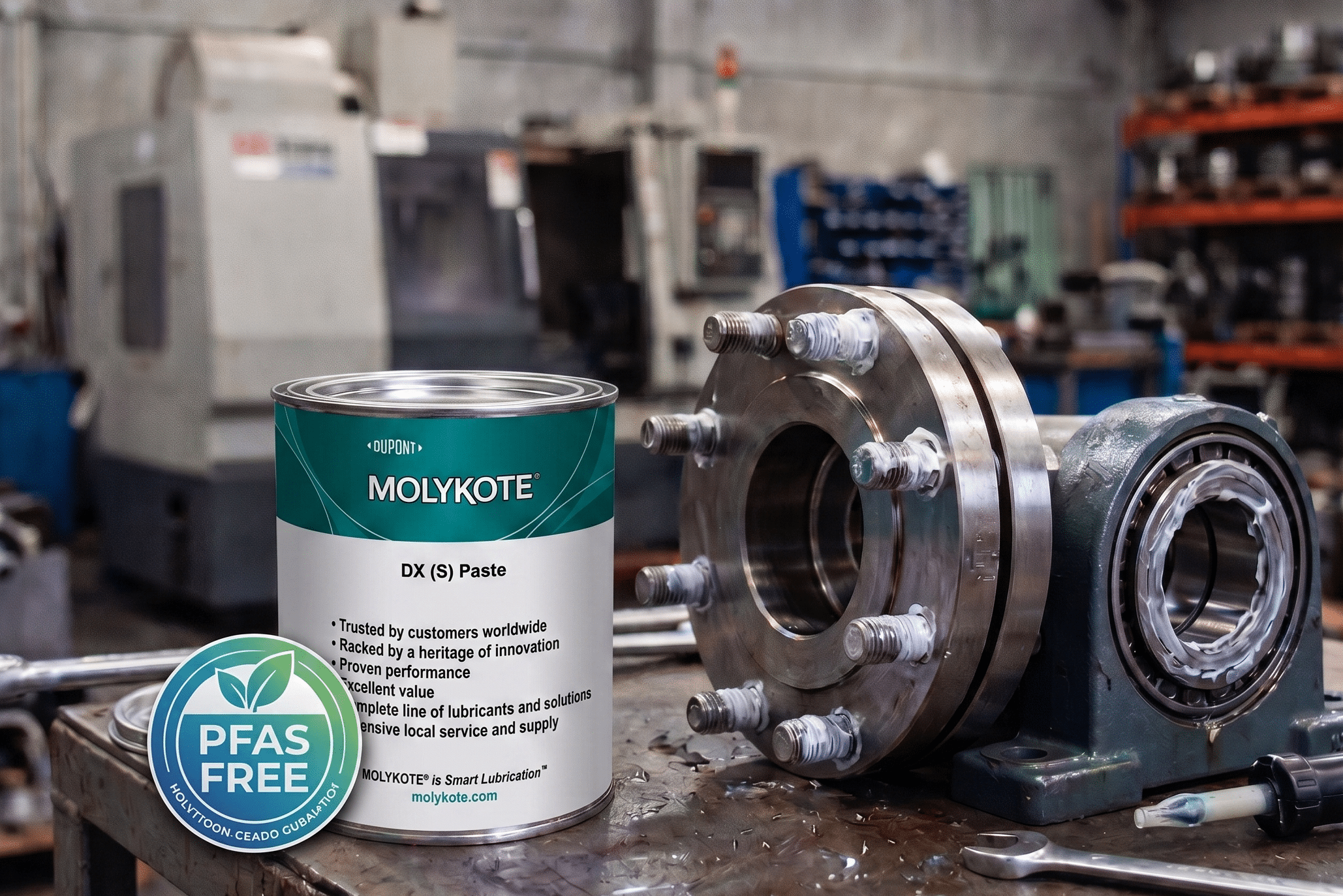
This article explains what PFAS-free industrial lubricants mean in practice, how the reformulated Molykote® DX(S), P-40(S) and G-4500 FMS deliver the same technical performance as their conventional counterparts, and how to plan a clean and compliant transition within your facility.
What Does “PFAS-Free” Actually Mean in Industrial Lubrication?
PFAS (per- and polyfluoroalkyl substances) are a family of more than 10,000 synthetic fluorinated chemicals widely used in industry for their resistance to heat, water, oil and chemical attack. They have powered decades of high-performance formulations — but they are also called “forever chemicals” because they persist in soil, water and living organisms, with growing evidence of bioaccumulation and toxicity.
A truly PFAS-free lubricant is formulated without any intentional addition of PFAS substances, including PTFE. According to the European Chemicals Agency’s updated restriction proposal under REACH, the lubricants sector is one of the priority categories under evaluation, with final committee opinions expected by the end of 2026.
For industrial buyers, this is a decisive signal: switching to PFAS-free industrial lubricants today means anticipating regulation, mitigating reputational risk and protecting operators from long-term exposure to substances of very high concern.
The Molykote® PFAS-Free Lineup at a Glance
Developed by DuPont™, the Molykote® Smart Lubrication™ range has been reformulated to remove intentionally added PFAS while preserving the technical envelope that engineers have relied on for decades. Three products lead this transition and form the core of any modern PFAS-free maintenance program.
| Product | Type | Service temperature | Primary applications |
|---|---|---|---|
| Molykote® DX(S) | White grease | -25 °C to +125 °C | Slides, cams, hinges, threaded assemblies |
| Molykote® P-40(S) | Assembly paste | -40 °C to +230 °C (up to +1200 °C dry film) | Screwed joints, braking systems, marine assemblies |
| Molykote® G-4500 FMS | Multi-purpose food-grade grease | -40 °C to +150 °C | Food, pharma and clean environments (NSF H1) |
Technical Advantages of PFAS-Free Industrial Lubricants
A common misconception is that removing PFAS forces a trade-off in performance. The reformulated Molykote® range demonstrates the opposite: properly engineered fluorine-free greases and pastes can match — and in several application areas exceed — the performance of legacy products.
Molykote® DX(S) — Long-life lubrication under load
Molykote® DX(S) is designed for slow-moving assemblies operating under high contact pressure. It is one of the most versatile PFAS-free industrial lubricants for general mechanical maintenance.
- Excellent water washout resistance in humid and washdown environments
- Corrosion and seizure protection on steel-on-steel contacts
- Clean, non-staining formulation for visible mechanisms
- Long re-lubrication intervals, reducing total maintenance cost
- Easy application by brush, cloth, spatula or centralized system
Molykote® P-40(S) — Extreme temperature anti-seize paste
P-40(S) is a high-load assembly and anti-seize paste built for environments where conventional lubricants fail. As one of the most demanded PFAS-free industrial lubricants for heavy industry, it covers an exceptional operating window.
- Outstanding wear resistance under shock loads
- Dry-film lubrication up to 1200 °C after carrier evaporation
- Metal-free composition, minimizing galvanic contamination risk
- Strong adhesion for long-term static assemblies
Molykote® G-4500 FMS — Food-grade versatility
G-4500 FMS is engineered for food processing, pharmaceutical and clean-room environments. It is both PFAS-free and heavy-metal-free, with NSF H1 registration for incidental food contact.
- Excellent thermal and chemical stability
- Substantially reduced re-lubrication frequency, lowering downtime
- Suitable for sensitive industrial settings where contamination is critical
Key Markets and Applications Across Europe
Demand for PFAS-free industrial lubricants is growing fastest in regulated and high-visibility sectors. Below are the main application areas where DGE customers are already transitioning.
- Food & beverage and pharmaceutical industries — where operator safety, hygiene and traceability are non-negotiable (G-4500 FMS, DX(S))
- Automotive and powertrain assemblies — high-load systems, threaded fasteners and driveline components (P-40(S))
- Electronics and precision equipment — residue-free lubrication of delicate mechanisms (DX(S))
- Marine, energy and heavy construction — extreme-load and corrosive environments (P-40(S))
- Railway and rolling stock — safety-critical assemblies subject to vibration, humidity and temperature swings (P-40(S), DX(S))
The European Regulatory Context: Why Acting Now Matters
Europe is moving toward one of the world’s most ambitious chemical restrictions. The PFAS restriction proposal under REACH, initially submitted by Germany, the Netherlands, Denmark, Sweden and Norway, was updated in August 2025 and is currently being reviewed by ECHA’s scientific committees, with adoption anticipated in 2027.
For manufacturers, three implications are already clear:
- Procurement specifications will increasingly require PFAS-free declarations from lubricant suppliers.
- Audit and CSR exposure will rise for plants still using fluorinated chemistry in non-essential applications.
- Transition periods in the final restriction will be sector-dependent, meaning early movers will operate from a position of compliance, not catch-up.
Adopting PFAS-free industrial lubricants today is therefore both a regulatory hedge and a strategic differentiator with customers who scrutinize their own supply chains.
PFAS-Free vs. Traditional Fluorinated Lubricants
Reformulated Molykote® products are not just compliant alternatives — they are competitive across the criteria that matter most in industrial settings.
| Criterion | Molykote® PFAS-free | Traditional PFAS-based |
|---|---|---|
| Oxidation resistance | Excellent | Excellent |
| Temperature range | Very broad | Very broad |
| Wear & corrosion protection | Very good | Very good |
| Operator safety | Optimal | PFAS-related health risks |
| Environmental impact | Positive — no persistent PFAS | Negative — persistent pollutants |
| Regulatory outlook (EU) | Future-proof | Under restriction (REACH) |
Frequently Asked Questions about PFAS-Free Industrial Lubricants
Why should PFAS be avoided in industrial lubricants?
PFAS are extremely persistent in the environment and accumulate in soil, water and living organisms. European regulators are restricting their use in industrial applications, and customers across automotive, food, electronics and energy increasingly require PFAS-free declarations from their suppliers.
Are PFAS-free lubricants as effective as traditional fluorinated products?
Yes. The reformulated Molykote® DX(S), P-40(S) and G-4500 FMS deliver wear resistance, thermal stability and longevity that match — and in several scenarios exceed — their predecessors. Independent tests have validated their performance under high load, high temperature and food-contact conditions.
Do these lubricants comply with HSE and food-grade regulations?
Yes. The Molykote® PFAS-free range is engineered to meet stringent Health, Safety and Environmental (HSE) standards, and G-4500 FMS holds NSF H1 registration for incidental food contact, making it suitable for food and pharmaceutical processing.
Do I need to purge existing lubricant before switching?
Ideally yes. To eliminate residual PFAS contamination and ensure full performance of the new lubricant, cleaning existing deposits is considered best practice. DGE technical specialists can advise on cleaning agents and procedures for each application.
Where can I source Molykote® PFAS-free lubricants in Europe?
DGE distributes the full Molykote® portfolio across more than 27 European countries. You can request a quote, technical datasheets and tailored application advice from our specialists, including support for pilot trials and full rollouts.
How long do I have to transition before PFAS restrictions take effect?
ECHA committee opinions are expected by the end of 2026, with the European Commission’s formal proposal anticipated in 2027 and sector-dependent transition periods to follow. For industrial lubricants, acting now positions your operations ahead of compliance deadlines rather than reacting to them.
Plan Your Switch to PFAS-Free Industrial Lubricants with DGE
Adopting PFAS-free industrial lubricants is one of the highest-impact decisions a maintenance team can take this decade: it reduces operator exposure, protects equipment, anticipates European regulation and signals environmental leadership to your own customers.
Molykote® DX(S), P-40(S) and G-4500 FMS prove that technical excellence and chemical responsibility can — and should — go together. DGE supports your transition with on-site assessment, product selection, technical documentation and supply across Europe.
Contact a DGE lubrication specialist to map your applications, validate the right Molykote® reference for each lubrication point and put a measurable PFAS-free roadmap in place.