
When a luminaire fails unexpectedly in the field, the commercial consequences extend well beyond the cost of a replacement part. Service call-backs, warranty claims, dissatisfied end-users, and damaged reputations are the real price of a poorly specified component — and one of the most frequently overlooked culprits sits right in front of the LED: the secondary optics.
Secondary optics — the lenses and lens clusters that collect, shape, and direct light emitted by LEDs — are often selected on the basis of initial optical performance and unit price. Thermoplastic materials dominate this space precisely because they combine good-to-excellent optical properties at relatively low material and processing costs. Yet this apparent economy can mask a significant long-term liability — one that the growing adoption of silicone secondary optics for LED luminaires is now making increasingly difficult to ignore.
Research on LED luminaire reliability has identified a wide range of potential failure modes, with estimates reaching up to about 130 unique modes across a typical light engine. Among them, lens degradation is particularly concerning because it can progress slowly and be difficult to detect, while eventually leading to significant optical performance loss or, in some cases, abrupt failure. For lumen maintenance commitments made to end-users — whether in tender specifications or energy-saving contracts — an unpredicted optical failure is not just a warranty issue. It is a credibility risk.
Understanding why this happens, and which materials are genuinely immune to it, is now a fundamental requirement for any luminaire manufacturer or specifier serious about long-term performance.
How Blue Light and Heat Degrade Thermoplastic Lenses
The primary degradation mechanism at work in silicone secondary optics for LED luminaires and their thermoplastic counterparts alike is photothermal aging: the combined and synergistic effect of high-intensity blue light irradiance and elevated operating temperature on the lens material. In a high-power LED luminaire, a secondary lens can be exposed to blue light irradiance levels between 0.7 W/cm² and 8.9 W/cm², with lens surface temperatures ranging from 75°C to 108°C under typical to demanding operating conditions.
To understand how different thermoplastic materials respond, it is useful to examine three categories that are widely used in commercial lens clusters today.
Polycarbonate (PC)
The polycarbonate lens is the most common thermoplastic choice for secondary optics. Under photothermal load, PC follows a two-stage degradation path. In the first stage, the yellowness index (YI) — a standardised measure of colour shift in optical materials used to track degradation in LED lens components over time — rises gradually. This initial phase can last thousands of hours and may remain within acceptable limits under standard lumen maintenance testing.
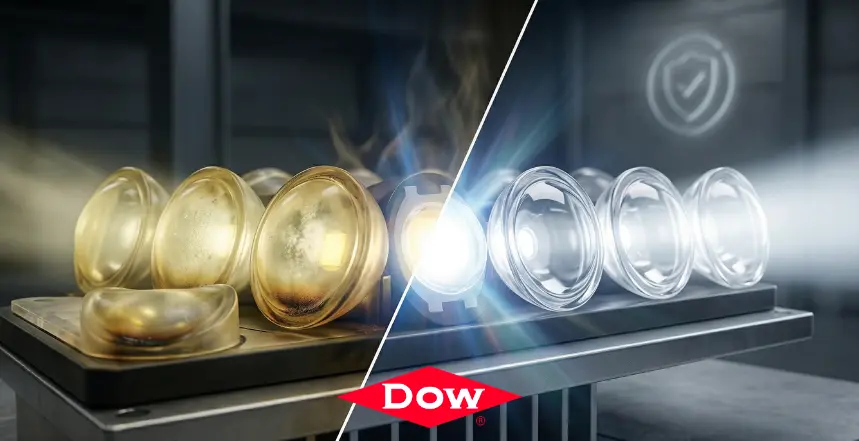
The danger lies in the second stage. Once the YI reaches a material-specific threshold — termed the Zone of Catastrophic Failure (ZCF) — a thermal runaway is triggered. This causes the lens to darken rapidly and severely, or in extreme cases, to melt. Critically, the YI threshold at which this runaway occurs varies dramatically between brands and even between batches of the same material type, depending on raw material composition, stabilising additives, and injection moulding parameters. There is no reliable single figure that specifiers can use to plan around.
PMMA
Polymethyl methacrylate (PMMA) optics for LED applications follow a similar two-stage degradation pattern. Below 80°C, PMMA lens clusters demonstrate stable YI performance across extended test periods. Above that threshold, however, the material fails — and notably, the first-stage yellowing prior to failure is far less pronounced than in PC, leaving even less observable warning before the onset of abrupt degradation.
High-Temperature PMMA (HT-PMMA)
HT-PMMA is marketed by some suppliers as a solution to the thermal limitations of standard PMMA, with ratings suggesting suitability up to 105°C. However, this temperature rating is based on the UL Relative Thermal Index (RTI) certification, which relates exclusively to the long-term behaviour of electrical and mechanical properties at elevated temperatures — not to optical properties such as transmittance or yellowness index.
In practice, HT-PMMA lens clusters subjected to photothermal test conditions demonstrate severely poor optical performance: pronounced yellowing, darkening, and the formation of bubbles within the bulk of the material. The RTI value, in other words, offers no assurance of optical durability whatsoever. Luminaire manufacturers who rely on this figure when specifying optics are exposed to a risk that the data sheet simply does not disclose.
Why TM-28 Testing Can Be Misleading
The ANSI/IES TM-28-20 lumen maintenance standard is the widely adopted methodology for projecting the long-term luminous flux maintenance of LED lamps and luminaires. It uses measured data from an accelerated test period and applies an extrapolation factor to project performance over the full intended lifetime.
For thermoplastic secondary optics, however, TM-28 extrapolation has a critical blind spot. In documented testing of a polycarbonate lens cluster under 1.7 W/cm² blue light irradiance at 102°C, the lens showed no indication of impending failure across 10,000 hours of testing. Standard TM-28 methodology, applied at various intervals between 2,000 and 10,000 hours, consistently projected acceptable lumen maintenance out to 30,000 hours (with three samples) or even 60,000 hours (with the full required sample set of ten).
The lens then failed catastrophically by rapid, severe darkening at 10,400 hours.
This is not an edge case — it is a structural limitation of applying a gradual-degradation model to a failure mode that is inherently threshold-driven. Abrupt lens failure in thermoplastic optics cannot be predicted using standard TM-28 methodology, and luminaire makers who rely on it alone to validate their optics specification are operating with incomplete information.
Silicone Optics: Stable Performance Under the Harshest Conditions
In direct contrast to every thermoplastic material category described above, optical-grade silicone lens clusters demonstrate a fundamentally different performance profile under photothermal load.
Across all test conditions — including the highest blue light irradiance tested of 7.7 W/cm² and lens temperatures spanning 81°C to 108°C — silicone lens clusters show excellent stability of the yellowness index throughout the entire test duration. After a brief initial period in which the YI actually improves (decreases) slightly, performance stabilises and remains exemplary. There is no two-stage degradation. There is no Zone of Catastrophic Failure. There is no thermal runaway.
This behaviour underpins why optical-grade silicone is increasingly described as an “apply-and-forget” material in the professional lighting industry: once correctly integrated into a luminaire, it does not require the extensive photothermal lifetime modelling that thermoplastic alternatives demand. The IEC 62717 performance requirements for LED modules define rigorous standards for LED component reliability — silicone optics are well positioned to meet and exceed these over the full intended service life.
Silicone optics are projected to outlast even high-performance LED packages, with L90 values exceeding 100,000 hours — meaning that 90% of initial lumen output is maintained well beyond the operational lifetime of most luminaire applications. For specifiers working to the Zhaga Book 15 specification for LED lens arrays, which defines standardised rectangular LED modules for use with lens arrays, this durability translates directly into design confidence.
Taken together, these properties confirm why silicone secondary optics for LED luminaires are increasingly specified in high-demand applications where thermoplastic alternatives would require extensive — and ultimately inconclusive — photothermal lifetime modelling.
For lighting professionals seeking optical-grade silicone solutions available through DGE Europe, this performance stability opens up application possibilities that thermoplastic materials simply cannot support.
The Business Case: TCO, Warranty, and Design Freedom
Silicone secondary optics for LED luminaires carry a higher unit price than their thermoplastic counterparts. This is a straightforward reflection of the more complex production process involved in manufacturing optical-grade silicone components. For procurement teams evaluating options on a line-item basis, this cost differential is immediately visible. The full picture, however, requires a total cost of ownership lens.
Warranty risk elimination
The most direct commercial argument for silicone is the removal of in-warranty catastrophic failure risk. A polycarbonate or PMMA lens that fails at 10,400 hours — within a typical three- to five-year warranty window for a commercial luminaire — generates service costs, replacement part costs, and reputational damage that can far exceed the price premium of a silicone alternative specified at the outset.
Energy efficiency over the full lifetime
Superior lumen maintenance over an extended service life means that the energy efficiency performance promised in a tender or project specification is actually delivered. Thermoplastic lenses that yellow progressively reduce luminaire efficacy before they fail outright — a degradation that is often invisible to the end-user but represents real energy waste and a shortfall against contracted performance metrics.
Luminaire design freedom
Perhaps the most underappreciated advantage of silicone secondary optics is the design latitude they enable. Because silicone tolerates higher photothermal loads without degradation, LED drivers can operate at higher currents and optics can be positioned closer to the light source — constraints that thermoplastic optics impose on luminaire designers are simply removed. This is not a marginal benefit: it directly affects the photometric performance, form factor, and thermal architecture of the entire light engine.
The extended durability of silicone also opens the door to architectural approaches that improve smart maintenance outcomes — including the physical separation of driver electronics from the light unit, enabling targeted component replacement without disturbing the entire luminaire. For high-performance LED light engine components designed around long service intervals, this modularity is increasingly a requirement rather than a luxury.
These are considerations relevant not only to luminaire manufacturers optimising their product portfolio, but to the end-users and facility managers who write the tender specifications — and who bear the operational cost of equipment that falls short of its projected performance.
What This Means for Lighting Specifiers and Procurement Teams
The practical implications of the evidence above are clear, even if the specification process does not always reflect them.
Do not rely on RTI values as a proxy for optical durability
Relative Thermal Index ratings from raw material suppliers describe the long-term mechanical and electrical behaviour of a polymer at elevated temperature. They say nothing about how that material will perform optically — how much it will yellow, whether it will crack due to embrittlement, or at what point it will enter a thermal runaway. Specifying thermoplastic optics on the basis of an RTI figure alone is an incomplete evaluation.
Do not treat TM-28 projections for thermoplastic lenses as a guarantee against catastrophic failure
As demonstrated, a lens can show no degradation signal for 10,000 hours, support extrapolated projections of 30,000–60,000 hours of safe operation, and then fail abruptly at 10,400 hours. The “time to abrupt failure” is a distinct parameter from lumen maintenance — and for thermoplastic optics in high-load applications, it is arguably the more important one. LightingEurope’s guidance on evaluating LED luminaire performance provides a useful framework for thinking about performance assessment beyond standard test methods.
Match the specification to the application load
For luminaires operating at moderate temperatures and modest irradiance levels — with sufficient separation between LED and lens — thermoplastic optics may perform adequately within the design’s warranty window, provided comprehensive photothermal characterisation of the specific lens from the specific supplier has been carried out. For high-load applications, dense optical designs, or any scenario where a catastrophic in-service failure would be commercially unacceptable, silicone secondary optics for LED luminaires represent the only material category with a documented record of unconditional long-term stability.
Frequently Asked Questions about Silicone Secondary Optics
What is the difference between silicone and polycarbonate optics for LED luminaires?
Silicone secondary optics maintain stable optical performance — including consistent yellowness index and lumen output — across the full range of photothermal operating conditions encountered in professional LED luminaires. Polycarbonate optics offer good initial optical quality at lower cost, but are susceptible to a two-stage degradation process that can end in catastrophic, unpredictable failure once a material-specific yellowing threshold is reached.
Why do thermoplastic LED lenses fail catastrophically?
Thermoplastic LED lenses fail catastrophically through a process of thermal runaway: once the yellowness index reaches a critical threshold — the Zone of Catastrophic Failure — the lens absorbs progressively more heat from the blue light it can no longer efficiently transmit, accelerating further degradation until severe darkening or physical meltdown occurs. This threshold varies by material brand, raw material composition, and manufacturing parameters, making it extremely difficult to predict using standard lumen maintenance test methods such as TM-28.
How long do silicone LED optics last?
Optical-grade silicone lens clusters are projected to achieve L90 lumen maintenance values exceeding 100,000 hours — meaning they retain at least 90% of initial light output beyond the operational lifetime of most professional luminaire applications. Unlike thermoplastic alternatives, silicone optics show no Zone of Catastrophic Failure under photothermal testing, and are anticipated to outlast even high-performance LED packages in the same light engine.
The Material Decision That Defines Luminaire Legacy
The lighting industry has spent decades optimising the LED itself — driving up efficacy, extending lumen maintenance, and pushing the boundaries of what a single semiconductor package can deliver. Yet a luminaire is only as reliable as its weakest component, and the evidence is compelling: for many thermoplastic secondary optics, that weakness is not a matter of if, but when.
The shift towards silicone secondary optics for LED luminaires is not a trend driven by marketing — it is a response to documented, measurable performance gaps that standard test methodologies have consistently failed to capture. Thermal runaway does not announce itself in a TM-28 report. The Zone of Catastrophic Failure does not appear on a material data sheet. But it does appear in the field, on a warranty claim, at 10,400 hours.
Dow, as a global leader in materials science and silicone innovation for the lighting industry, has built a portfolio of optical-grade silicone solutions engineered precisely to eliminate this category of risk. DGE Europe, as an authorised distributor with deep technical expertise in advanced LED components, is positioned to help luminaire manufacturers and lighting specifiers translate that material advantage into confident, future-proof product decisions.
The choice of secondary optic is made once, early in the design process, and its consequences last the full lifetime of the luminaire. Speak with DGE Europe’s technical team to ensure that choice is the right one.
–>