Electronics that run hot often fail in predictable ways: throttled performance, shortened component life, and design constraints that force bigger heatsinks or louder cooling. A well-chosen conductive compound helps by lowering the thermal resistance at the interface, so heat moves out of critical components more efficiently.
At DGE, we’ll analyze two Dow options—DOWSIL™ TC-5888 and DOWSIL™ TC-5960—what they are, where they fit, and how to choose between them.
Why thermal interfaces become the bottleneck
Even when a heatsink and a chip look “flat,” microscopic surface irregularities trap air pockets. Air is a poor heat conductor, so the interface can end up limiting the whole thermal path—especially as power density climbs.
What these materials are designed to do
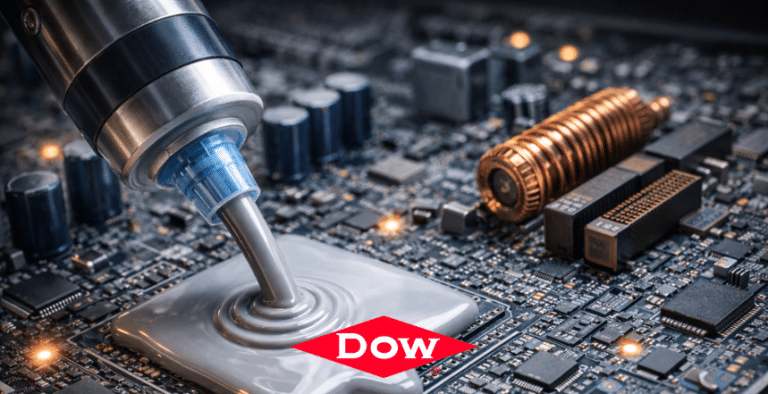
Both products are one-part, non-curing, gray, thermally conductive materials intended to dissipate heat in electronics by minimizing thermal resistance at the interface and serving as a thermal interface material (TIM).
What to look for in a non-curing TIM material
- Thermal conductivity (how readily the material transfers heat).
- Thermal resistance at a specified bond-line thickness / gap (how the interface performs in a thin layer under defined conditions).
- Printability and rheology (how well it stays in place and how easy it is to apply with manufacturing-friendly methods).
Meet DOWSIL™ options
DOWSIL™ TC-5888: built for MPUs and power modules
DOWSIL™ TC-5888 is a one-part, gray material with 5.2 W/mK thermal conductivity, formulated to dissipate heat in electronics applications such as microprocessor units (MPU) and power modules. It is of non-curing and low thermal resistance.
From Dow’s listed benefits, it targets manufacturing practicality as well: no cure required, solvent free formulation, and screen printable application, with thixotropic behavior described as low slump.
In plain terms, this conductive compound is positioned for designs where you want a stable, easy-to-apply TIM layer without a curing step, while prioritizing low interface resistance.
DOWSIL™ TC-5960: tuned for bare die applications
DOWSIL™ TC-5960 is also a one-part, gray, non-curing material designed to dissipate heat, but it is specified for bare die electronics applications and listed with 6.0 W/mK thermal conductivity with low thermal resistance.
Key differentiators in the benefits include excellent pump-out resistance for bare die application and high thixotropy (index of 9), plus screen- and stencil-printable application, no cure required, and a solvent-free formulation for stability.
Besides, these silicone greases are an alternative approach in assembly: they can be used in place of PCMS or thermal pads and can print right onto the product.
If your main concern is maintaining interface performance in a bare-die context, this conductive compound is the one explicitly called out with pump-out resistance and stencil printing support.
How these products address common thermal-management problems
Lowering thermal resistance where it matters most
Thermal resistance values are specified for defined thin gaps in both products:
- TC-5888: 0.05 °C-cm²/W at a 20 µm gap
- TC-5960: 0.03 °C-cm²/W at a 16 µm gap
For teams wrestling with hot spots and tight packaging, those numbers matter because the interface layer is often one of the easiest places to reduce thermal bottlenecks without redesigning the whole cooling stack.
Streamlining assembly with one-part, non-curing handling
Both products are described as one-part and no cure required, which helps avoid cure scheduling and post-application process constraints.
On top of that, these print-based application methods are highlighted:
- TC-5888: screen printable
- TC-5960: screen- and stencil-printable
If your production line already relies on printing steps, this can simplify integration compared with approaches that require more complex placement or additional curing controls.
Staying where it’s placed
Rheology and stability are two of their main advantages:
- TC-5888 is thixotropic with low slump.
- TC-5960 lists high thixotropy (index of 9) and pump-out resistance for bare die.
That matters when the interface must remain consistent through handling, assembly pressure, and operating conditions—especially in bare-die contexts, where interface control is typically less forgiving.
TC-5888 vs. TC-5960: how to choose
Choose DOWSIL™ TC-5888 when…
- Your application aligns with Dow’s stated targets like MPUs and power modules.
- You want 5.2 W/mK conductivity and Dow’s published 0.05 °C-cm²/W at 20 µm gap performance point.
- Screen printing and low slump behavior are a fit for your process needs.
Choose DOWSIL™ TC-5960 when…
- You’re working with bare die electronics applications and want the product Dow positions specifically for that use case.
- You want Dow’s higher listed conductivity of 6.0 W/mK and the published 0.03 °C-cm²/W at 16 µm gap value.
- You value pump-out resistance for bare die and screen/stencil printing options.
At selection time, treat the “right” conductive compound as the one that matches your component type (MPU/power module vs. bare die), your printing method (screen vs. screen/stencil), and the performance points for thin-gap thermal resistance.
Implementation notes and where to learn more
Dow includes “Materials Training” resources on both product pages, describing videos that cover why heat protection matters, types of thermally conductive materials, handling/dispensing methods, and tips for choosing silicone solutions for thermal management.
Those resources are the best next step if your team needs guidance on practical handling and decision criteria beyond the headline specs, since they come directly from the manufacturer’s technical education content.
The right finish for thermal decisions
If overheating is putting performance, reliability, or packaging flexibility under pressure, these two Dow materials offer a clear, non-curing TIM approach with published conductivity and thin-gap thermal resistance values. DOWSIL™ TC-5888 focuses on electronics such as MPUs and power modules, while DOWSIL™ TC-5960 is positioned for bare die needs and adds pump-out resistance plus stencil printing support. The best final choice is the conductive compound that aligns with your device architecture and your production method—then validated against Dow’s stated performance points and technical guidance.