
Electrification programs in e-mobility face a tight set of realities: heat must move efficiently away from cells, packs must survive vibration and shock, and every gram matters—all while high-volume lines demand predictable, fast assembly.
If you’d like to learn how we are improving battery performance, at Dow we’ll explain how our solutions are helping manufacturers enhance battery safety, durability, and performance.
A portfolio built for battery packs
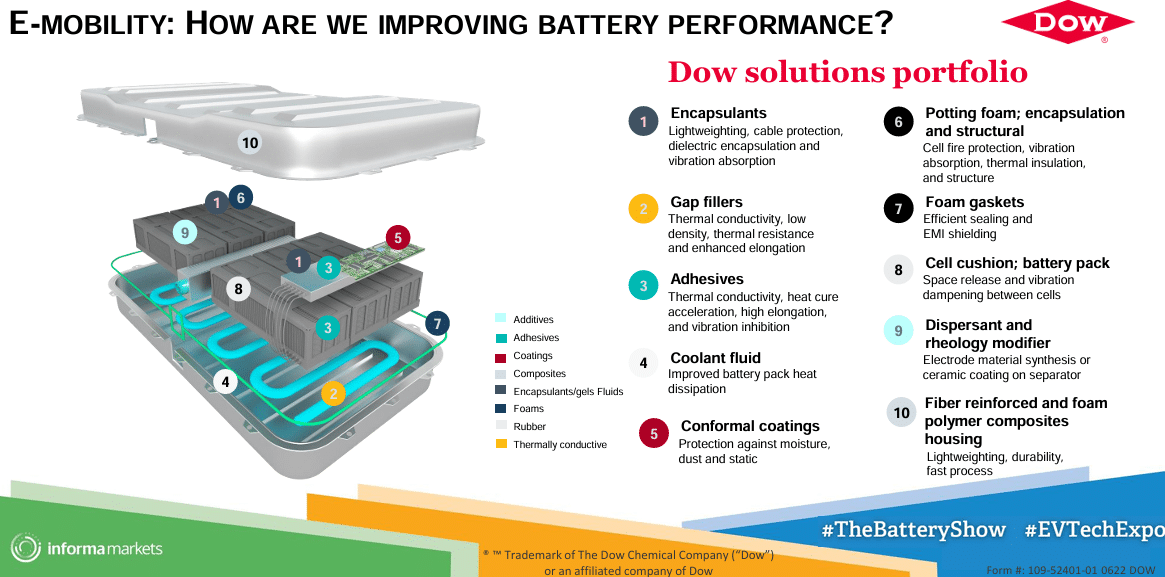
A complete portfolio maps directly to pack-level needs: encapsulants and gels, thermally conductive gap fillers, structural and potting foams, adhesives, conformal coatings, foam gaskets, coolant fluids, composites and rubbers, plus dispersants and rheology modifiers for electrode processing. Each family targets specific functions—lightweighting, sealing, shock and vibration control, thermal conductivity, dielectric protection, and EMI shielding—so engineers can cover the full set of battery requirements with purpose-built materials.
What each material family addresses
- Encapsulants & gels: lightweighting, cable protection, dielectric encapsulation, and vibration absorption.
- Thermally conductive gap fillers: improved heat dissipation with low density and thermal resistance, plus elongation for durability.
- Adhesives: thermal conductivity options, heat-cure acceleration, high elongation, and vibration inhibition for durable bonding.
- Coolant fluids & conformal coatings: moisture, dust, and static protection with better pack heat dissipation.
- Potting foams & structural foams: cell-level fire protection, vibration absorption, thermal insulation, and structural contribution.
- Foam gaskets: efficient sealing and EMI shielding.
- Composite housings: fiber-reinforced and foam-polymer options for durability and faster processes.
- Elastomers & dispersants: EPDM cushions between cells; acrylate or PEG dispersants and rheology modifiers for electrode synthesis and ceramic separator coatings.
Module assembly aligned to real pack architectures
The module build-ups for prismatic/pouch and cylindrical formats highlight where each material enters the stack: silicone or polyurethane adhesives for parts assembly, encapsulants for thermal management, gap fillers bridging cells to cold plates, EPDM rubber for inter-cell cushioning, and foams for fire protection. This layout makes it clear how the e-mobility bill of materials translates into practical hardware choices.
Materials science levers for E-mobility
Flexibility comes from the ability to draw on organic, inorganic, and hybrid chemistries, combine portfolios to widen physical-mechanical property ranges, and use computational and experimental device-scale modeling to set material property targets. For e-mobility programs that must balance heat transfer, stiffness, elongation, and processing behavior, these levers shorten iteration cycles and cut risk.
Structural bonding that withstands real loads
VORATRON™ MA 8200 Series adhesives
For cell-to-module, cell-to-pack, and cell-to-chassis bonding, the VORATRON™ MA 8200 Series provides high mechanical strength with process-friendly curing. The data set includes:
- Lap shear (Al/Al): > 9 MPa (0.3 W and 0.4 W versions), > 8 MPa (0.3 W×), > 5 MPa (1.3 W).
- Cross-tensile (Al/Al): > 9 MPa (0.3 W and 0.4 W), > 8 MPa (0.3 W×), > 5 MPa (1.3 W).
- Storage modulus: 300–600 MPa (0.3 W, 0.4 W), 500–800 MPa (1.3 W).
- Elongation at break: 250–300% (0.3 W×).
- Thermal conductivity options: 0.3, 0.4, 0.3, and 1.3 W/m·K variants.
- Processing: two-part, room-temperature cure with open time > 20 minutes across variants.
High cross-tensile strength behavior across displacement reinforces suitability for joints that see complex loading in operation—relevant to crash and vibration regimes typical in e-mobility duty cycles.
Thermal management that balances conductivity and assembly
VORATRON™ GF-1000 Series gap fillers
Thermally conductive gap fillers support efficient heat flow between cells and cooling plates while enabling low-energy assembly. The GF-1002 grade features:
- Thermal conductivity: 2 W/m·K
- Density: 2 g/cm³
- Squeeze force for placement: ~100–120 N, reducing energy input during assembly
- Rheology: shear-thinning and not self-leveling, aiding placement control
These properties align with the theme of better reliability when gap fillers are used within the stack alongside coolant channels and cold plates.
Sealing, insulation, and EMI control for pack integrity
Beyond core bonding and thermal pathways, the portfolio includes foam gaskets for sealing and EMI shielding, conformal coatings for environmental protection (moisture, dust, static), and coolant fluids to improve pack heat dissipation. These elements close key risk gaps—electrical interference, contamination ingress, and thermal-runaway propagation paths—without adding unnecessary mass. For e-mobility platforms, this completeness reduces supplier sprawl and simplifies validation.
Micro-mobility batteries: potting that adds strength
For e-bikes and similar micro-transportation packs, the VORATRON™ EY-708 & EP-516 potting system lists mechanical targets that support structural stability in compact geometries:
- Foam tensile strength: > 3.5 MPa
- Foam shear strength: > 1 MPa
- Foam density: ~ 280 g/cm³
These figures point to a potting approach that stiffens and protects cell arrays while contributing to shock and vibration performance—concerns shared across the e-mobility spectrum.
Predictability: modeling flow and dwell to de-risk production
A recurring B2B pain point in e-mobility is process variability—whether a material will dispense, flow, and cure as expected at scale. The predictive capability segment shows Degree of Fill (DoFF) prediction and contrasts behavior at different initial viscosities over time (e.g., 800 cP vs. 4000 cP). This type of modeling helps teams anticipate fill patterns and densification during cure, informing bead design, venting, and cycle times before committing to tooling and automation.
Why this toolkit matters for E-mobility programs
Fewer trade-offs across thermal, structural, and mass targets
The combination of adhesion strength, toughness, and stability with organic, inorganic, and hybrid chemistries supports integrations such as cell-to-chassis bonding while maintaining thermal pathways and compliance where needed. For e-mobility engineers, the ability to tune stiffness, elongation, and conductivity within a compatible set of chemistries shortens iteration loops and reduces re-qualification risk.
Clear placement within the battery stack
Exploded views position adhesives at cell stack interfaces and gap fillers between modules and the cooling plate, clarifying exactly where each material provides value. That clarity accelerates design reviews and aligns suppliers around the same functional map—useful when multiple stakeholders are converging on an e-mobility launch.
Process-ready properties
Two-part, room-temperature cures with defined open times, predictable flow and fill behavior, and low squeeze force installation for gap fillers map to throughput needs on automated lines—critical for e-mobility programs chasing cost parity and consistent quality.
Implementation notes for decision-makers
Match properties to location and load case
- Use high cross-tensile adhesives where modules must carry structural load (e.g., cell-to-pack joints).
- Apply 2 W/m·K gap fillers to bridge cells or modules to the cooling plate, targeting low thermal resistance without excessive assembly energy.
Design for reliability with multi-function materials
- Favor foams and encapsulants that add vibration absorption and thermal insulation, contributing to fire protection and stability in confined spaces.
- Incorporate foam gaskets and conformal coatings early to lock in IP/EMI performance requirements and speed environmental testing.
Use modeling to de-risk scale-up
- Leverage flow and fill predictions to validate bead patterns, residence times, and venting before ramp.
A practical path to better battery packs in E-mobility
This application-mapped set of materials and capabilities helps e-mobility teams manage heat, structure, sealing, and process risk at once—from VORATRON™ MA 8200 structural adhesives and GF-1000 gap fillers to foam potting for micro-mobility, gaskets, coatings, and device-scale modeling.
The emphasis on defined properties and clear placement within the pack allows stakeholders to make faster, lower-risk decisions for e-mobility programs. To discuss how these insights can support your roadmap, contact DGE for more information.